Serving your country is one of the biggest sacrifices you can make. Every year, 180,000 Americans make that sacrifice and join the United States of America’s military, according to Military.com. These brave individuals choose to leave behind their everyday lives, family, and friends to put their bodies on the line and take on the job of protecting their country.
Many of those soldiers never come back from the service as the same person once they experience the trials of war. Whether mentally or physically injured, veterans often face a lot of problems and find it difficult to cope with the huge change in their everyday life when returning home from their military service.
With the sheer number of veterans, there are many organizations in the United States created to help veterans by holding events that support bonding and help with transitional skills to help veterans make the change from service member. The Warrior Hockey League combines those necessary transitional skills with the love of ice hockey.
“The team has given me a sense of purpose,” says Eric Drennen, a veteran of the war in Afghanistan and Flyers Warriors player. “It rekindled the military brotherhood that many of us are in search for after completion of our time in the service. The program gives us an outlet and surrounds us with like-minded individuals who are currently dealing with service connected disabilities.”
Drennen plays for the newest addition to the Warrior Hockey League, the Flyers Warriors, who are based in Philadelphia, Pennsylvania and are directly affiliated with the National Hockey League’s Philadelphia Flyers.
How It Started
In founding the Flyers Warriors team, it was important to not only put together a competitive team but create a community. “The main goal of the team was to establish a community and network of disabled veterans who could use each other through the game of hockey to enhance their lives and to fulfill the burning desire to be a part of something greater than oneself,” says Drennen.
Leading the way was former Flyers Warriors President Rick Stabeno, who relayed a short and sweet message to the Philadelphia Flyers in late 2018.
“The call was very simple: ‘I’m a Flyers fan, I’m a veteran, I’m a hockey player, I would like to start a team in the Philadelphia area. Can you guys help me?’ As it turns out, that was all it took as the Flyers helped jump start the team with a $50,000 donation.
“The donation allowed us to get the ball rolling for ice time and equipment. The affiliation is certainly important because the exposure of the team is greater than if we were independent,” Drennen remarked.
The team was officially formed in early 2019 and launched with a ceremony in the Flyers locker room days before the Flyers Stadium Series game at Lincoln Financial Field against the Pittsburgh Penguins.
Brad Marsh and the help of former NHL players
The exposure from the NHL affiliation has helped the team grow to 65 players of varying hockey experience, from recreational to college-level. However, it’s been the dedication of former NHL player Brad Marsh has helped the team continue to stay true to the organization.
Marsh, the current coach and alumni president of the Flyers Warriors, spent 15 years in the NHL from 1978 to 1993 and spent seven of those years in Philadelphia with the Flyers.
“He has been monumental in our growth. His dedication to our cause is the reason many of us show up to practice and skate our bodies to death,” Drennen remarked. “He is a well-respected man that we all idolize and appreciate more than he will know. He provides us with an insight to the game that only a former player can give. He tells stories and shares insider information about his experience as a professional hockey player. It is both hysterical and applicable to life. It is a true blessing.”
Along with Marsh, many former players have played a role in the growth of the team and players. Former Flyers Bob Kelly, Bobby Clarke, Dave Brown, Mark Howe, Bill Clement, Keith Jones, Todd Fedoruk have all spent time with the Warriors team.
“The cycle of former players is seemingly endless,” says Drennen. “It was always an amazing experience meeting players that you grew up watching. It is equally amazing to hear behind the scenes stories and to have the ability to ask them questions about memories from childhood. Many of the players have shown up to practice and just recently we literally had a former player or coach on a zoom call every week during the COVID crisis shutdown. They present us with life advice, hockey advice, and basic support just by showing up and being there.”
Creating a support system for veterans
While time in the military has pushed many service members to their limits mentally and physically, returning home is also a major obstacle for veterans to face.
Drennen refers to the return home as “by far the biggest obstacle that we face as a community.”
According to Drennen, the ability to build relationships proves to be tough for him and most veterans. “It is nearly impossible to feel a wholesome connection to anyone who didn’t serve upon returning and to those who haven’t seen and been affected by the gruesome, unnatural, and evil nature that is warfare, the warrior program provides us all with the missing connection.”
This is one area that the Flyers Warriors has really been able to help most veterans adjust. It gives them a place to build meaningful relationships.
“My wife and son give me reason to live but it is the program that gives me the necessary outlet and void-filling spark that is needed by many veterans to sustain a purposeful life.”
Another one of the other hardest transitions to make is leaving a structured life in the military and transitioning to a less-organized life outside the military.
“In the military, there exists a ton of structure, hierarchy, and purpose, Drennen states. “After getting out, all of that is essentially stripped away leaving many veterans lost and unsure of the future-especially those with a disability.”
While the Flyers Warriors players all share in their military experience and a love of ice hockey, some also share in the struggle of dealing with disabilities from their time in the service.
According to a 2019 study by the Bureau of Labor Statistics, 25 percent of veterans suffer from some type of disability. With disability being such a large obstacle in many veteran’s lives, the Flyers Warriors have provided a space for disabled vets to play hockey and find others dealing with similar situations.
When it comes to disabilities, the Warrior Hockey League requires that each player is dealing with at least a 10 percent disability, but it does not necessarily mean a physical disability.
“The majority of the players do have physical disabilities but not in terms of missing limbs on our team specifically,” says Drennen. “There are veterans who are amputees that play on other warrior teams and there are many programs that assist those individuals. Although we are all disabled it is not something that is routinely discussed during official team events. We have conditions such as PTSD, hearing loss, and other various mechanically based issues that we deal with internally, with the support of our fellow veterans and with the help of outside veteran assistance programs.”
Helping the Veteran Community
While the Warriors program does a lot for its players, it also allows players to find time to help other veterans in the community. Drennen believes that it is key to help all vets, saying that “the Warriors biggest and most fulfilling accomplishments have been its willingness to participate in many events throughout the year. Everything from raising funds for a fallen or injured warrior, assisting at the Flyers Wives Carnival, being part of the Veterans Day parade, assisting with alumni events, and organizing special at home visits for other veterans.”
“While we all love to play, the program truly is a veteran outreach program that simply uses ice hockey as the medium to do so.”
Success on the Ice
Though the results on the ice are certainly secondary to the importance of building a support system for veterans, the team has actually had some great success during their short tenure in the Warrior Hockey League.
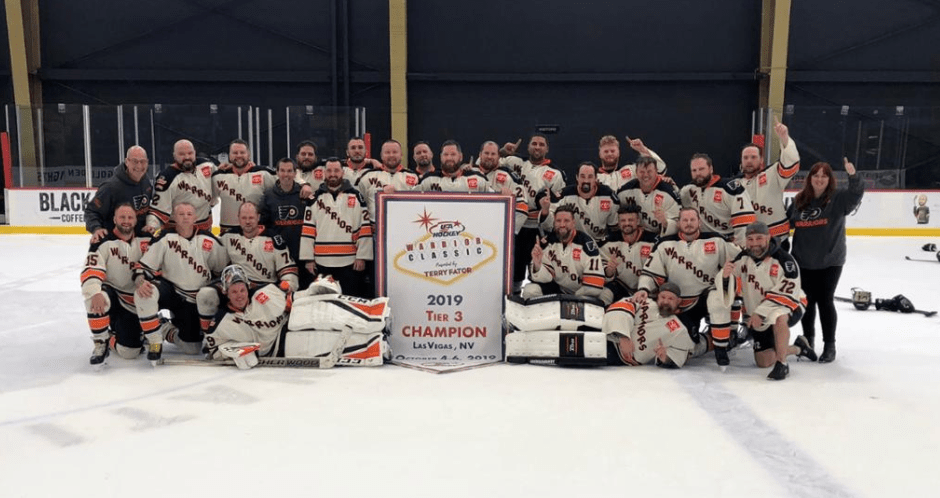
In their first-ever tournament, the team posted a 5-0 record at the Tier 3 Warrior Classic Tier in Las Vegas, Nevada, beating out fellow Warrior teams from Iowa, Nebraska, Washington D.C., Colorado, and finally North Carolina in the championship game as they took home the title.
“The national Las Vegas tournament last October was by far the biggest team accomplishment,” Drennen reflected. “I had joined the team after the win but that was an amazing story. The biggest obstacle with that was simple. We had just formed the team a few months prior and without playing with each other much, went on to win a national event-impressive for sure.”
“It was a remarkable run,” said Drennen. “We were a very new team going against guys that had been playing together longer than us but we really found our groove during those 5 games. It definitely wasn’t a cakewalk though. Our second game against Nebraska we ran into a hot goalie who just seemed to stop everything but we got it done. We trailed by a goal three different times in the championship game against Carolina. It was a battle, but we proved that we were ready for it.”
Unfortunately, the Flyers Warriors will not get the chance to defend their title in 2020 as the Warrior Hockey Classic has been cancelled due to the COVID-19 pandemic.
“It’s definitely hard being away from all the guys and getting out on the ice. We were really looking forward to defending our title this year but I guess we’ll have to settle for being the champs for another year,” Drennen joked.
A Look to the Future
The Flyers Warriors team has been a huge success on and off the ice despite their short existence. Winning a championship their first year while providing local veterans with something they desperately crave after leaving the service – brotherhood.
But their work is definitely not done yet. With problems amongst the veteran community such as homelessness, unemployment, and mental health, there is still room to grow for the Flyers Warriors.
These issues still plague the veteran community and are areas the Flyers Warriors hope to improve in their community along with the rest of the Warrior Hockey League.
“The biggest goal for us as a program is to touch as many lives as humanly possible,” says Drennen. The veteran community is a small but very close-knit community. We understand each other and have more respect for each other than any other occupation in the world. It is our goal to use the game of hockey and the desire to be once again part of something greater than self to promote and reinstate the special bond between service men and women.”
Featured Image from the Flyers Warriors Facebook Page
 Dean Snock's Blog